Downsizing into a tiny house gave me a fresh perspective on the work I do with my clients as a professional organizer. Why are people so attached to things? I often wondered. Why did they keep so much of so little value? After 20 years of coaching others through the process I got a taste of my own medicine. What I had ignored for years now had to be gone through, every drawer and toolbox, every storage box and zippered portfolio. A long and tedious process it was too. I found things that were long obsolete—air mail paper and replacement flashlight bulbs of another era. It all came up for review. Familiar things that had been with me for so long they felt like a part of my identity, a part of what I called home. But through the lens of the tiny house, home had to be redefined.
As I do with clients, I addressed my hoard in categories to make the work linear and compartmentalized so my mind would feel focused, less overwhelmed. I used other incentives too. I passed along items as high up on the food chain as I could to increase its value. I sold my pre-digital camera equipment on e-bay so I would know it would be utilized by someone willing to pay for it. And I was happy to provide such equipment to appreciative art students. I posted low cash items to free cycle to find those who would value the item — stamp albums from childhood for instance and got a lovely note of appreciation from a grandma and her grandson. I took the trouble to drop off recyclable items at the right places because it was the right eco thing to do. For nice clothes and housewares I chose a boutique thrift store that raised money for a local charity and was staffed by volunteers who cared about the items and moved things along efficiently. Such a venue seemed to make it easier to give away these "too good to throw out" items. Now I know how much this means to my clients.
Then there are items that regretfully can only be trash. But I was glad the time had come to get rid of all those padded envelopes that had secreted themselves between things. I kept back one to return a part I mis-ordered worth only $3.49, but it took returning it to make me feel better about it.
The rest of my life had already been downsized by changes I had made over the last 20 years as I describe below. Still the discipline of 150 sq. ft. would push that even further.
Clothes
Some categories were easy. B
eing forced to part with clothing gave me permission to cull out pieces that were perfectly good, but that I felt ambivalent about and just needed a reason to give away. I didn't have a huge collection of clothes to begin with since I had stopped buying new items when I joined a yahoo group called
The Compact in 2006. Started by ten friends in San Francisco after they realized that they spent every weekend at the mall, they made a compact to buy nothing new for a year then opened their group to the public. A bit of publicity swelled their ranks to 1,000 in a week. I hadn't been spending every weekend at the mall, but I had ordered clothes regularly from an online discount store. The clothes were such bargains that I had felt compelled to stock up as so many people do. The group encouraged thrift shopping and DIY projects. Refashioning clothes came into my consciousness.
As part of this up cycling practice I started sewing shirts cut down from large men's shirts I found at thrift stores in fabric I liked. Sewing my own clothes kept me more interested in wearing the same ones, confident that they were unique and timeless.
After the culling I measured what was left in my closet and went back to my tiny house floor plan. I allotted a bit less of that measurement as my space for clothes—a 36" rod for hang space and shelving on either side for folded pants. A 4" space on both ends would hold t-shirts folded in quarters lengthwise. Six feet of closet space in all; relatively large for a tiny house even though it would mean dressing in the loft lying down as one would in a tent. I would have a sleep in closet as it were. From a tip online I squeezed in more space by switching out my fat plastic hangars for skinny metal ones. I liked those plastic covered drip dry hangars of old but they were no longer available in stores and I wanted sturdier ones than wire ones from the dry cleaners. I ordered three different kinds before I found
sturdy chrome ones. Sixty was just enough with the handful of drip dry ones I already had.
I also added my chest of drawers to the mix. The contents of the top drawer had so many categories of little things I couldn't face going through it all. The top of the chest also doubled as my dressing table. While the bottom drawer contained my prized collection of board shorts. This was enough to justify finding a place for it at the back of the tiny house next to the shower pan. The bottom two drawers would hit the wooden box of my toilet and thus only open hallway, but I could always move the toilet out of the way if required.
The chest also had sentimental value as it was one I had from childhood that I had, in my twenties, hand painted in a turquoise sponged on a cream background and decorated with a stylized design of arrows copied from a native American painting I had admired. The front had black lines of a geometry inspired by Frank Loyd Wright and the handles were bright red. The piece being a remembrance of the design influences of my youth would tie in nicely with my teal green kitchen cabinets and the red desk. My color preferences having remained in the same palate.
In the final reckoning I was able to cram all my hanging clothes that I wore everyday onto the rod. The cramming inspiring more culling until everything fit easily. The shelf space for pants was just right and the space for t-shirts was twice what I needed. Huzah—a bonus space to stash things. Under the eaves the odd triangular spaces were perfect for folded underwear. There was still my fancy dress clothes many of my own design that I had sewn myself. I thought to store them offsite, but I found large storage boxes with lock down lids that would just squeeze in under the house. I got four. One for the clothes, one for boots and dressy shoes, one for bags, one for cycling gear. These were my concessions to things I wanted to keep, but didn't need on an everyday basis.
Office
My book collection was much more difficult for the books were chosen for their usefulness as reference books for gardening, home repairs, clothing design and carpentry. Skills for when the grid went down and there was no internet access. Not to mention my collection of large books on tiny houses that would serve to educate visitors. I faced this challenge by building as many shelves as I could fit up the face of one wall where my desk would be and over the area where the seating would be. This endeavor took a while and drove home the point that if you are faced with building storage space for everything you want to keep you have to work really hard which might lead you to think twice about what you choose to bring on board. I also had an interim solution. I installed shelving in an unused closet in my stepmother's garage where I could stage the books until I figured out how many I could fit on the shelves I was building. And either store or give away more books.
The more arduous task of culling came down to the little things—office supplies, stationary and bathroom sundries. Things tend to accumulate if you have the space. Pads of paper, printer paper of different weights, envelopes bought in bulk, fancy gift notebooks, pens; all of it mostly gifts, free samples and giveaways. This was the territory of it-could-be-useful-one-day.
A surprisingly easy task was culling photos. I had already done the work of putting them in albums and had organized the remaining ones chronologically. The ones in the albums were enough I realized and threw out most of the old, distributing a few among friends. Sometimes being hyper organized does pay off.
My two drawer file cabinet had to go so all my files had to be gone through to reduce everything down to what would fit in an ottoman storage unit and a rolling file cart. The rolling file cart would also hold my flatbed scanner and the ottoman would be home for my shoulder bag for everything now had to do double duty as well as fit under my desk. For my laser printer I built a specially sized shelf above the desk. This reconfiguration reduced my entire office to half the space. And I could still have my Xena Princess Warrior action figure riding my art class clay elephant on my window sill along with my glow-in-the-dark virgin Mary statue and my vintage all metal postal scale.
Bathroom
The bathroom was easier. I had revised my bathroom sundries in my search for less packaging. I now made my own toothpaste from baking soda, salt, mint extract and glycerine. I washed my hair with baking soda chased with an apple cider vinegar rinse. This left my hair squeaky clean, but the biggest benefit of this regime was that I only had to wash my hair every other week since it now maintained a healthy grease free look. (Shampoo is the cause of that greasy look since it is a detergent that strips the natural oils from the hair stimulating the hair follicles into overproduction of oils to replace what was stripped off.) Not having to wash my hair every other day was the reason why I knew I could live without hot running water and a shower head in my bathroom. For this twice a month ritual I could plan to go to a friend's house and wash my hair.
And except for hand washing I don't use soap because it dries my skin. I brush my skin with a natural bristle brush as I bath. After I dry off I rub olive oil into my skin and a little lotion on my face. And I like a heavy duty cream for my feet and hands. For deodorant I use a mix of cornstarch and baking soda as needed. Thus I had cut out all the astringents, toners, bath gels, facial and body scrubs, scented lotions, specialized soaps, conditioners and shampoos that don't work after a month or two but were so expensive you keep them in the hopes of rotating them back in as you switch brands. I also don't wear make-up. I had basically returned to a lifestyle more familiar to our pioneer grandmother's. In my work I have observed that most women have an average of ten banker's boxes of sundries stuffed into their bathroom. I had just three small drawers for my toothbrush, contact lenses and neti pot. All plus travel kits fit in my two much longer drawers installed into the end of my kitchen counter.
Kitchen And Utility Closet
The kitchen was simple. I just brought over what I was using and enough dishes and silverware for four which was as many bodies as I could imagine entertaining inside the tiny house. The depth of the kitchen counter created ample space in my cabinets. I had measured the heights and widths of my pots and pans and planned what food items I wanted to store, as well as all the lunch boxes and thermoses so all the shelving was at the right height for everything.
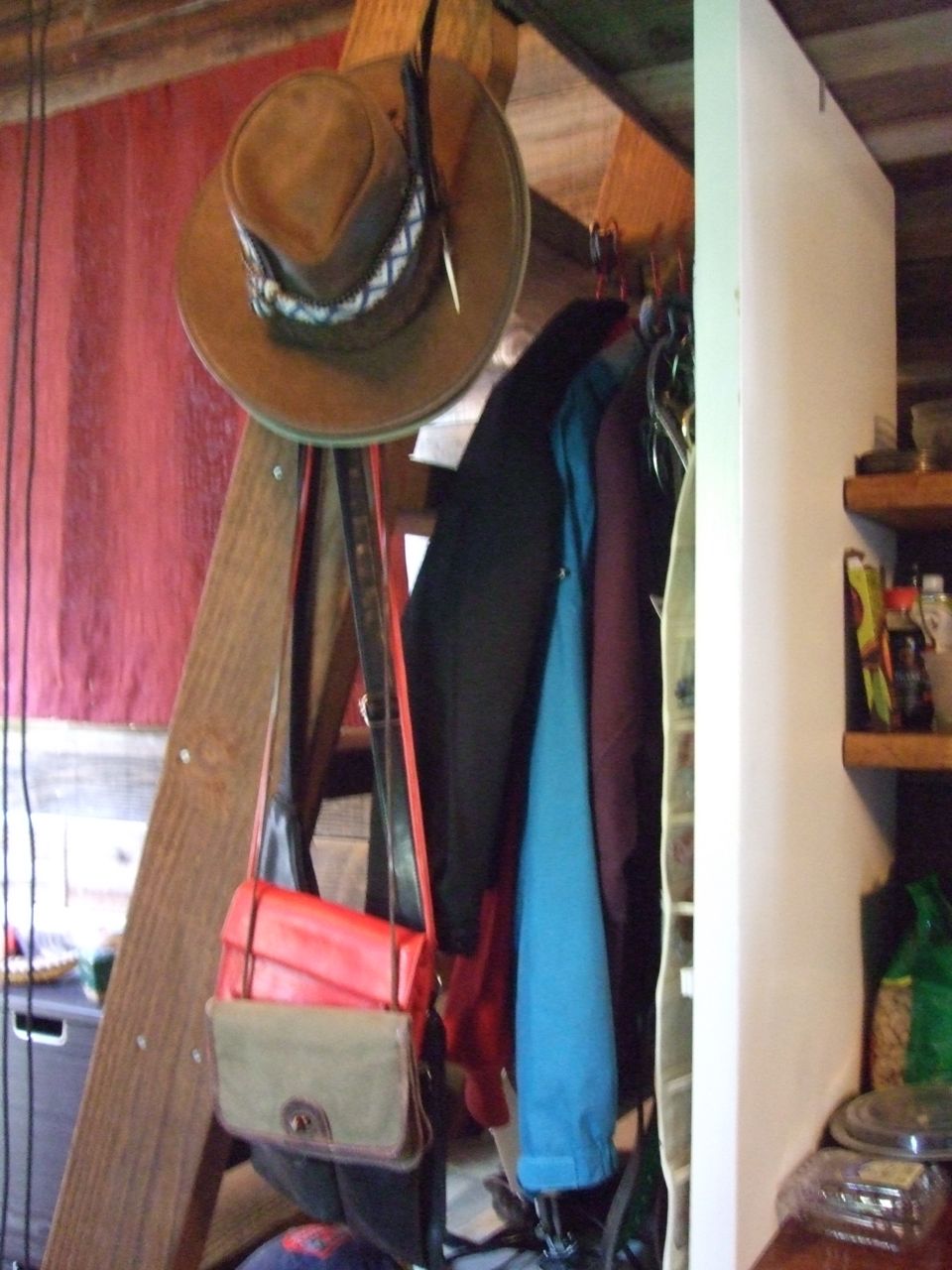
On a tiny house forum someone had said that you would be surprised how much you can fit in so don't be in a hurry to throw everything out. This proved to be good advice as I devised ways to support all my on board accessories by bringing my things over a little at a time and finding ways to store it. A client who had owned a VW bus she traveled in for two months told me how she stored fruit in net bags hung on hooks. This was a useful idea too and I put up such a bag which I ended up using for recycling. I also installed 3 hooks to hang my large collection of caps and hats. My jewelry became decor as I hung a rack up in front of the window over the toilet and arranged all my pendants in a pleasing composition.
Under the stairs I had installed a short closet rod for a coat closet (and a shorty folding ironing board). This I had planned in the original layout cutting back the kitchen counter by nearly a foot and installing a wall at the end of the counter to support the side of the coat closet. On the closet rod I also put a hanging jewelry organizer a client gave me that would prove immensely useful with all of its see through pockets. As I swept through my old room picking up all the little things lying around that I didn't want to lose—keys to things, ear buds, hearing aid batteries, chap stick, digital memory card, small parts to things, my tiny analog address book—I put them in the pockets of the hanging organizer. This gave me tremendous piece of mind during the move and was apt storage after the move in lieu of a kitchen drawer.
I also had room under the stairs for my rolling utility table upon which I did my sewing and shoemaking. I would store my sewing machine on it. It fit quite nicely as I had hoped and had a shelf underneath where I kept my sewing gear. The coats hung over the sewing machine partially hiding it. On the wall under the stairs, behind the utility table, I installed hooks to hold my backpack, tote bag and sling bag.The remaining space under the stairs went to tools and a mini vacuum cleaner.
I made one concession to Ikea, a shoe cabinet by the door I found for half price on craigslist as soon as I thought of it. The brilliance of this shoe cabinet design hiding the shoes and allowing for a shelf for outgoing items. The flat cabinet face and dark faux woodgrain gave a finished look to my foyer.
On the ladder itself an antique three prong hook would hold small purses, my hat and any coats visitors came in with. One of my storage benches was also dedicated to sewing gear. There was also space in the loft along one wall to park a few things I hadn't planned for—a zippered plastic bag of sewing projects, a laundry hamper and a magazine holder. This completed everything I had had in my one room living space.
I still had lots more I would have to deal with that I had stashed in storage under the house and in the garage. Wood, spare parts, material to fix things, memorabilia. Stuff that had driven my partner crazy, but for now I had what I needed to sustain life in my tiny house.
There was just one more layer to go. The four walls of artwork I had—my signature piece from art school that later became my business card design, my grandmother's ornate high school diploma, a small abstract canvas a client painted, a mask of a tiger from Mexico. I had to retire my wall size Thai hanging of a walking tiger and a poster size print of the Golden Gate half built. My life is no longer half built I thought as I took it down. What I brought over I hung on the one wall over the door to the peak of the 12' roofline. The spacing was so challenging it took all my sense of composition to get it just right. Interestingly each piece had some red in it that was picked up by the red of the door. The tiny house was thus transformed into a gallery space, a place of purpose befitting a working artist.
As a finishing touch I had an alpaca fur wall hanging I got on my recent trip to Peru to put over my couch. I hung it over the mirror that I had already installed there and this made the space more traditionally a sitting room. Now it was home and I was ready to show the house. Just in the nick of time as my first visitors were
documentary filmmakers traveling across the country in their tiny house. I had met them at their tiny house presentation and a few days later they dropped by to interview me. And what fun it was showing off my handiwork to fellow travelers who would appreciate all the compact design innovations I had installed.
 The first months of living in the tiny house was a work in progress. Dishwashing continued to be a challenge as my dish rack did not quite hold utensils. And the drying mat it was attached to was looking a little grubby plus I didn't like the way it flopped over the toaster oven.
  Then at a thrift store I came across one of those European racks that look like a patch of grass. People mostly use such a design to dry baby bottles or small items, but for so little money I could give it a try. I pulled out my slide out extension to try it out, but later realized that it fit perfectly on top of my toaster oven and there it lives.
 Tiny house designers like to put things on the wall with lots of brushed steel and magnets, but I didn't have that much wall space as it was taken up by shelving for my dishes. I put my cooking utensils into a mason jar and I was happy with my tray for eating utensils which lay at the back of the counter. I still needed a place to put my chef's knife. I spent some time thinking of nifty ways I could mount a single knife holder to my wall, but it didn't look right to have just one utensil on the wall so I grabbed my available magnets and temporarily attached the knife to the shower wall. The effect was somewhat macabre, but had a certain witty presence. I still haven't got around to gluing the magnets in place, but the arrangement would suffice.
 For a while I had a TV in my loft and my loft became my living room. I covered the bed with a queen size comforter I had on hand that had a nice homey pattern. I didn't like looking at all the noise of my clothes on hangers and wanted to hang a curtain across the rod. Then in a simplifying moment I realized the comforter was so much bigger than my mattress there was probably enough of it to reach up to the closet pole so I hung a couple of bulldog clips from the hangers at each end and clipped the comforter to the pole. As a final touch a client offered me her framed poster of the ceiling of the Sistine Chapter. It amused me to affix it to my ceiling and was just the right distance for studying this work of art.